A door opened by the computer
We will examine the details in the pages ahead, but the Quran’s relationship with the number 19 begins to reveal itself at first glance.
The Quran’s opening formula, ‘Bismillahirrahmanirrahim,’ consists of 19 letters. The Quran contains 114 surahs:
This opening formula appears at the beginning of 113 of the Quran’s 114 surahs. It is absent only from surah 9. Yet what appears to be missing is restored exactly 19 surahs later, when the same formula occurs again in verse 27:30. The total number of occurrences of ‘Bismillahirrahmanirrahim’ in the Quran thus returns to 114.
In other words, the book’s opening formula has 19 letters; the number of surahs is a multiple of 19; and the total number of occurrences of that formula in the Quran is also a multiple of 19.
We will return to these details in later sections.
This is only the beginning.
One of the most striking gateways into the Quran’s 19-based structure is formed by the special letters that appear at the beginning of certain surahs.
Almost everyone who reads or listens to the Quran in Arabic has encountered these letter combinations: Alif Lam Mim, Ya Sin, Ha Mim, Qaf, Nun, Sad…
These letters are not words, nor do they form a sentence in the ordinary sense. ‘Ya Sin,’ for example, is often treated as a name in popular usage, but it actually consists of two letters: Ya and Sin. Likewise, ‘Alif Lam Mim’ is simply three distinct letters placed side by side. They occur at the very beginning of certain surahs, after which the normal sequence of verses continues.
Traditional literature calls them huruf al-muqatta‘at, or ‘disconnected letters.’ In this study, I will use the more descriptive term ‘initial letters.’
Initial letters occur at the beginning of 29 different surahs, yet the number of verses containing them is 30. The reason is surah Ash-Shura: Ha Mim appears separately in 42:1, while Ayn Sin Qaf appears in 42:2. Later sections will show how important this seemingly small detail becomes in certain mathematical structures.
Much has been said about these letters over the centuries. Some scholars held that only God knows their meaning; others assigned symbolic meanings to them; still others passed over them without dwelling on the question. At first glance, they can indeed look like unexplained signs standing at the opening of the text.
But one point should be stated clearly:
The Quran is not a ‘book of secrets’ sent to humanity. It is not a book of magic, talismans or symbols that no one can understand. In its own words, it is a message sent to warn the living. (See Ya Sin, 36:69–70.)
We must therefore ask:
And they do not occur once or twice, but at the beginning of 29 surahs and in 30 verses altogether.
Consider this analogy:
What legal effect would a statutory provision have if no one could read it and it had never been published in the Official Gazette?
Why would the Creator place verses consisting of only a few letters, whose meaning no one could ever know, in the final scripture sent to humanity?
Perhaps the problem was not that these letters carried no meaning. Perhaps the tools needed to examine them did not yet exist.
People in the period when the Quran was revealed could certainly count, trade and perform mathematical operations. But they did not have a world of text processing comparable to what is available today.
Scanning a text of thousands of verses letter by letter, counting how often particular letters occur across hundreds of verses, comparing results between surahs and checking those operations repeatedly would have been extraordinarily difficult.
Nor is it enough for one person to perform the counts. A claim must also be independently verifiable by others.
Other possibilities that we now take for granted were also absent for most of human history. Widespread education, high literacy, broad access to basic arithmetic and easy access to information are all relatively recent. Today, an ordinary reader can understand a simple division, scan tens of thousands of characters with a few keystrokes and check whether a stated number is correct.
For centuries, that was not the case.
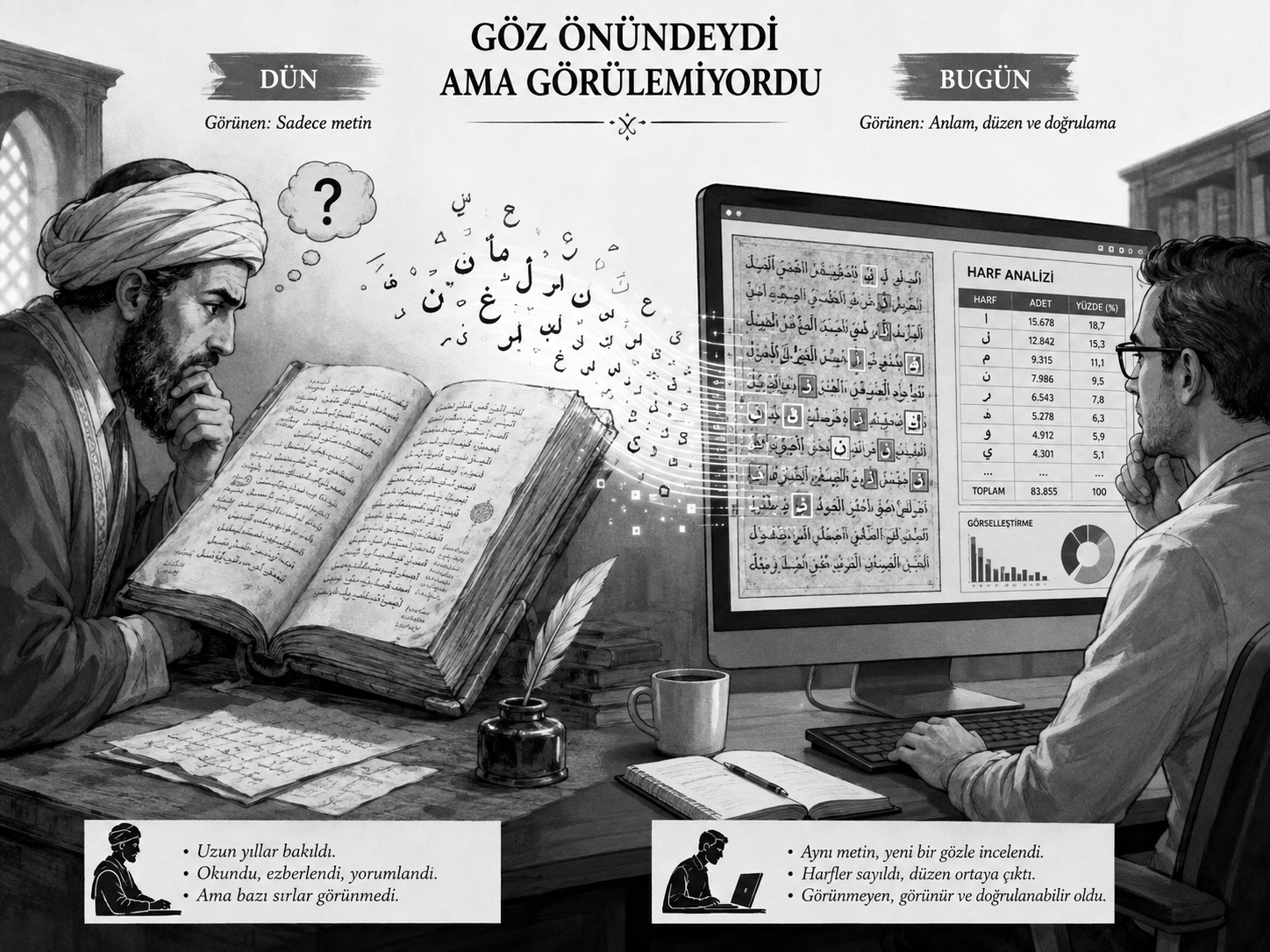
At last, the computer age made it possible to look at these initial letters in an entirely different way.
We may not know what a letter means, but we can count how many times it occurs in a text.
We can examine how a group of letters is distributed through the surah it introduces.
We can compare how often the same letter recurs in different surahs.
More importantly, we can test whether the resulting numbers are randomly distributed or repeatedly converge on the same common factor.
A computer adds nothing new to the Quran. The text is the same. The letters are the same. The verses are the same.
What has changed is the set of tools with which we can examine them.
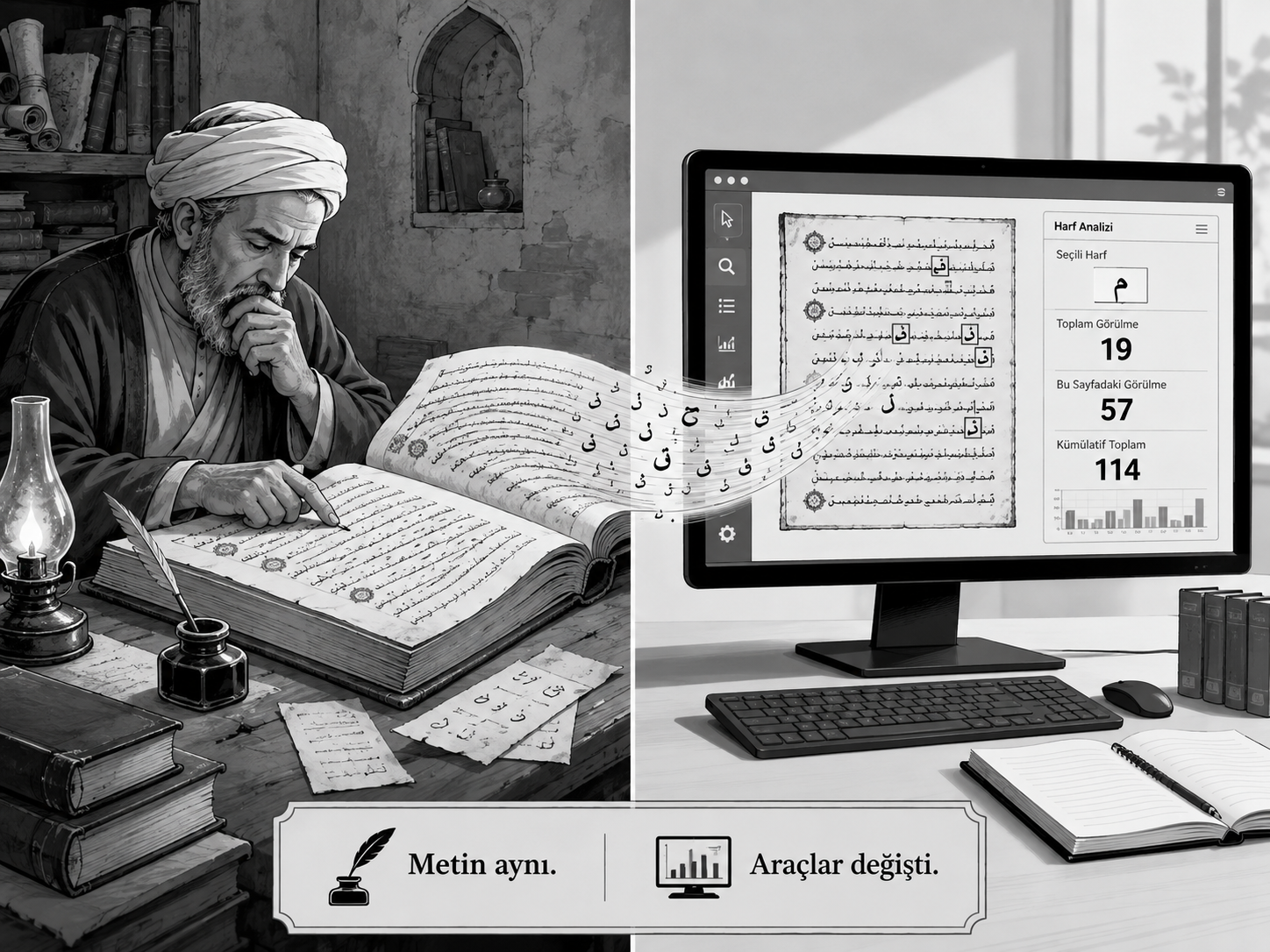
The fact that a structure in the Quran became visible in the computer age does not mean that it came into existence in the computer age.
Something may have been present from the beginning without being equally visible in every age.
The Quran itself contains striking examples of things that were not to be brought to light immediately, but at an appointed time.
When the reason is explained for repairing a wall belonging to two orphans during the journey with Moses, the text says:
(18:82) ‘As for the wall, it belonged to two orphan boys in the city, and beneath it was a treasure that belonged to them. Their father had been a righteous man, so your Lord intended that they should reach maturity and then recover their treasure. This was a mercy from your Lord. I did not do any of this of my own accord. This is the explanation of what you could not bear patiently.’
The treasure was already there.
But the time for it to be uncovered had not yet come.
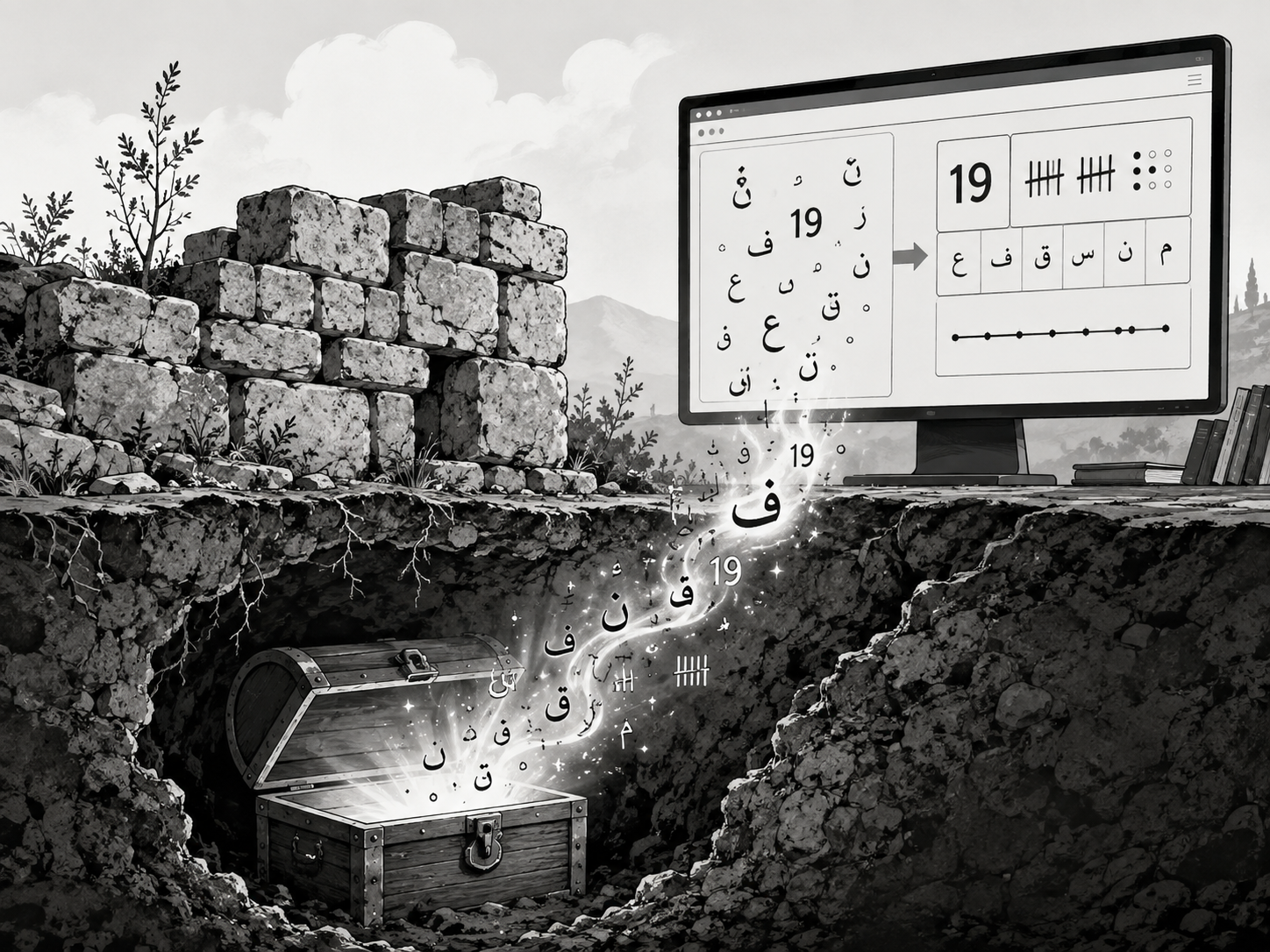
Perhaps this is the point to consider here as well:
The fact that something has been present in a text from the beginning does not mean that it was intended to be revealed immediately.
The Quran’s initial letters stood before people’s eyes for centuries. The letters did not change. The text did not change. What changed were the questions humanity could ask of the text and the tools with which those answers could be tested.
With the computer age, it became practical to examine the whole Quran systematically, letter by letter, compare counts and verify the resulting figures again and again.
Now let us look at what lies behind that door.
In surah 50, which opens with Qaf, the letter Qaf occurs 57 times:
In the surah that opens with Ya Sin, the combined total of Ya and Sin is 285:
Across the seven surahs that open with Ha Mim, the combined total of Ha and Mim is 2,147:
In the surah that opens with Ayn Sin Qaf, the combined total of these three letters is 209:
In surah Maryam, which opens with Kaf Ha Ya Ayn Sad, the combined total of these five letters is 798:
In the surah that opens with Nun, the total number of Nuns is 133:
Let us pause and consider this.
In the following sections, we will not merely state these results. We will place the verses and letters before the reader and make the counts as visible as possible. No figure will have to be accepted solely on our word.
For now, however, let us simply consider the pattern before us.
In any text, it is not impossible for the total of a randomly selected letter to be a multiple of 19. The rough probability is 1 in 19. If we encountered only one example, we might regard it as an interesting but limited coincidence.
But this is not a single example.
The repeated appearance of the same common factor across different surahs and different groups of letters presents a very different picture.
If, merely as an intuitive approximation, each of the six examples above is treated as having a probability of 1 in 19, the chance that all six converge on the same common factor is:
This corresponds to that probability.
Approximately one in forty-seven million.
I do not present this as an absolute or final statistical model, because the letters occur within the same text and have structural relationships with one another. The calculation is intended only to give the reader an intuitive sense of scale.
Even under the simplest approach, however, the picture is this:
And these examples do not constitute the whole mathematical structure of the Quran.
They are only the beginning.